Comparison · For the office of the CFO
Aurelytix vs. Claude Code
for finance teams
Two capable AI tools, built for two different jobs. One helps engineers ship software. The other turns your fragmented financial data into answers a CFO can trust. Here is an honest look at where each belongs — and why finance work belongs in a platform built for finance.
AI is moving into the finance function. The real question is which AI.
By 2026, Gartner expects 90% of finance functions to deploy at least one AI-enabled technology. The direction is settled; the choice of tool is not. As general-purpose AI agents like Anthropic's Claude Code earn a reputation for doing real work, a fair question reaches the CFO's desk: could a tool like that simply run our finance analysis too?[1]
It is a reasonable question, and it deserves an honest answer. Claude Code is an excellent product — for the job it was built to do. Finance is a different job. This page sets out the distinction plainly, credits Claude Code for what it does well, and explains why the office of the CFO is best served by a platform built for finance from the ground up.
Two tools, two jobs
Claude Code
A general-purpose coding agent
In Anthropic's own words, an "agentic coding tool that reads your codebase, edits files, runs commands, and integrates with your development tools" — available in the terminal, IDE, desktop app and browser. It is built for developers, and it is genuinely very good at that.[5]
Built for
Software engineers building and shipping software
Aurelytix
Purpose-built AI finance automation
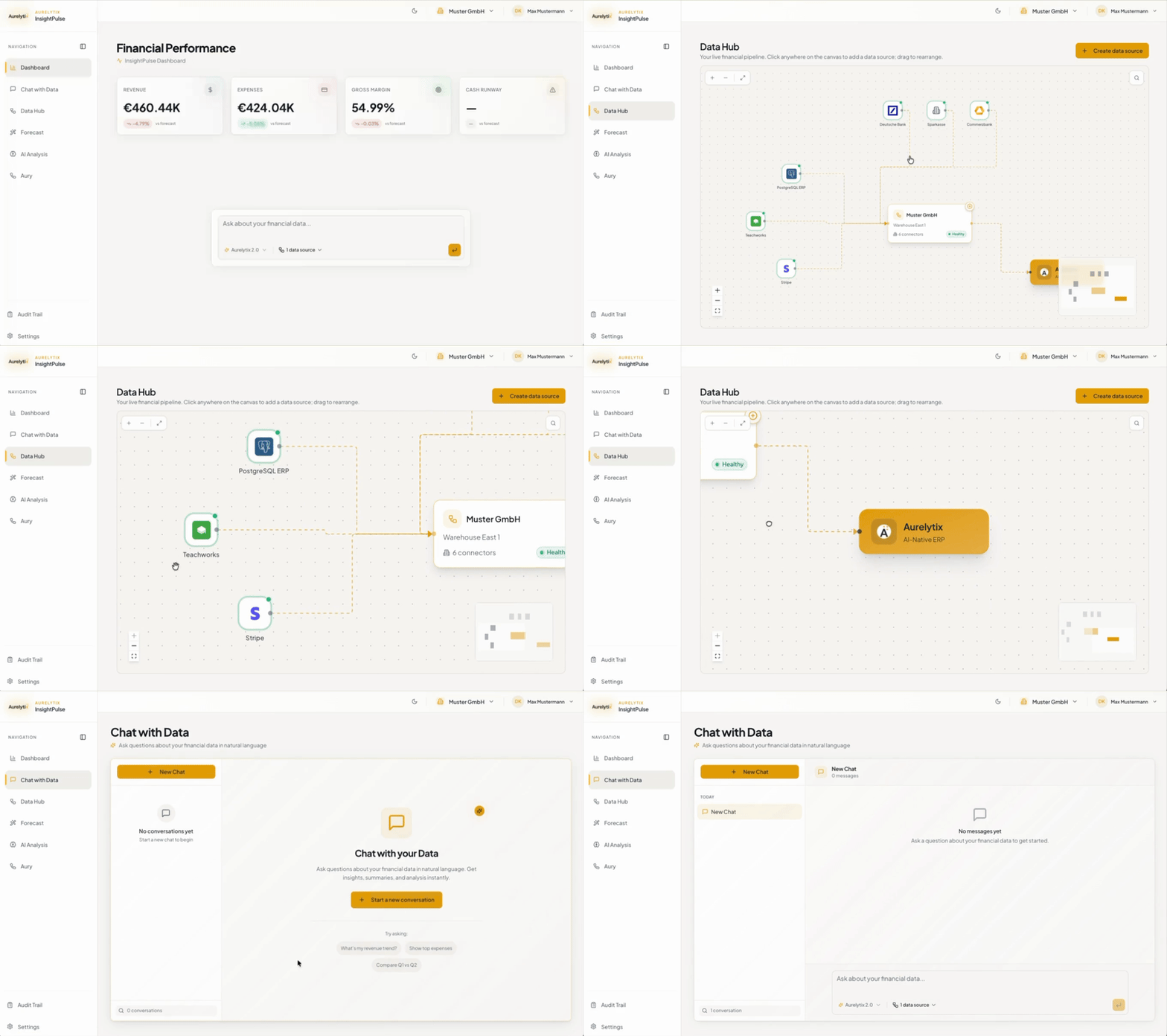
Purpose-built, AI-driven finance automation for the office of the CFO. It connects to the banks, accounting systems and payment providers you already use, reconciles everything into one set of trusted books, and lets your team ask questions in plain language — answered from your own reconciled ledger, not the open internet. And you can ask out loud: with Hey Aury, our conversational assistant, your numbers are a phone call away — answered in about a minute, from anywhere.
Built for
CFOs and finance teams who need answers they can sign their name to
The CFO's reality
The numbers a finance leader actually lives with
These pressures don't ease as a company scales from €100M toward €2B in revenue — they compound. More entities, more banks, more ERPs and more people touching the numbers turn manual consolidation, slow closes and shaky data into a structural risk — precisely when the decisions get bigger. This is the reality a mid-market finance team operates under every month.
Up to 30%
of a finance team's time can be lost to avoidable manual rework — at this scale, tens of thousands of hours a year.
[2]Gartner, 2019~40%
of CFOs do not completely trust the accuracy of their own organization's financial data.
[3]BlackLine, 20246.4 days
Median time to close the books each month — and the slowest quartile still takes 10+ days.
[4]APQC / CFO.com, 201890%
of finance functions are expected to deploy at least one AI-enabled technology by 2026.
[1]Gartner, 2024Head-to-head
Aurelytix vs. Claude Code, side by side
An honest, like-for-like comparison for finance work. Claude Code is not a finance product — so for finance, much of what Aurelytix ships on day one is something you would otherwise have to build and maintain yourself.
Aurelytix
The office of the CFO
Claude Code
Software engineers
Aurelytix
Your finance team, in plain language
Claude Code
Developers, in the terminal and IDE
Aurelytix
Built in — banks, DATEV, ERPs, payment providers
Claude Code
You build and maintain each one yourself
Aurelytix
Built in and automated
Claude Code
Not a finance product — you build it
Aurelytix
Every answer traces to your reconciled ledger
Claude Code
General model; grounding is your responsibility
Aurelytix
Hey Aury — ask by phone, get answers in about a minute, from anywhere
Claude Code
Not a finance tool — no voice line to your books
Aurelytix
Every figure traceable to its source record
Claude Code
You design and maintain it
Aurelytix
Human approval gate before anything changes
Claude Code
Not included
Aurelytix
Bank-grade, EU data residency, strict tenant isolation
Claude Code
You own the security of whatever you build
Aurelytix
Native to the platform
Claude Code
General-purpose, not finance-specific
Aurelytix
Days, on systems you already run
Claude Code
A software project you staff and run
Aurelytix
Aurelytix
Claude Code
You, indefinitely
This comparison reflects each product's stated purpose. Claude Code is a general-purpose coding tool; the "Claude Code" column describes what adopting it for finance would require of you — not a shortcoming of the product within its own domain.
A coding agent makes you the software vendor
Point a general-purpose coding agent at your finances and you have not bought a finance system — you have signed up to build one. The bank and accounting connectors, the double-entry ledger, the reconciliation logic, the audit trail, the security model: all of it becomes your team's to design, secure and maintain, indefinitely.
Everything you'd have to own — before a single finance insight
Servers & infrastructure
Cloud hosting, containers, autoscaling, load balancers, backups, disaster recovery
Language & app stack
Backend services, web frontend, API layer, background jobs, framework upgrades
Databases & data
Transactional database, analytics warehouse, schema migrations, data pipelines
Integrations
Bank feeds, accounting & ERP (DATEV, SAP), payment providers, file imports — each one built and kept alive
Security & compliance
Encryption, access controls, audit logging, GDPR, SOC 2 / ISO, penetration testing
Monitoring & reliability
Logging, metrics, alerting, uptime SLAs, on-call rotation, incident response
Finance domain logic
Double-entry ledger, reconciliation, period close, GAAP / IFRS rules
Identity & access
SSO, MFA, roles & permissions, multi-tenant data isolation
Aurelytix ships every one of these on day one — reconciled, audited and secured. Build it yourself, and each box becomes your team's to run, forever.
That work is rarely as cheap as it first looks. A landmark study of 1,471 IT projects found an average cost overrun of 27%, with one in six projects overrunning by 200% on average. And the bill never stops arriving — Stripe's research puts the typical developer at more than 17 hours a week on maintenance and technical debt. For a finance team without a software department to spare, that is the wrong project to own.[6, 7]
A general model isn't grounded in your ledger
The deeper issue is trust. A general-purpose model answers from its training and whatever you paste into it — not from your reconciled books. In finance that gap has a price: even purpose-built professional AI tools were found to fabricate answers 17–33% of the time in a Stanford study, and general chatbots fared considerably worse. As Deloitte observes, in finance "a difference of only 0.5% could, in certain situations, amount to millions of dollars."[8, 9]
This is not a hypothetical risk. The accounting profession's own guidance is blunt: today's general-purpose AI tools "have not been formally educated and trained in the practice of public accountancy and are not licensed CPAs," and must be supervised accordingly. Aurelytix takes the opposite approach — every answer is computed from your own reconciled ledger, so the figure on the screen is one you can stand behind.[10]
Finance runs on governance and auditability
Financial reporting is not only analysis — it is controls. Double-entry, segregation of duties, and internal control over financial reporting exist so that every number can be explained and defended. A general coding agent has no concept of any of this out of the box; you would have to build the guardrails yourself, correctly, and then prove that they work.[14]
Aurelytix is built the other way around. Nothing changes your books without passing a human approval gate, every figure carries a complete audit trail back to its source record, and the whole platform runs with bank-grade security and EU data residency — built and hosted in Germany — with strict separation between tenants. Governance is the product, not an afterthought bolted on later.
Where the industry is heading
Finance is going purpose-built, not general-purpose
The market is converging on exactly this distinction. Gartner expects 80% of large enterprise finance teams to rely on internally managed AI grounded in their own proprietary data by 2026 — not generic chatbots. Leading investors describe the same shift: in regulated fields, durable advantage comes from deep workflow integration and domain context, the very things a horizontal tool cannot easily replicate. The honest version of this thesis is narrow but real — in a specialized, regulated domain like finance, the value lives in the grounding, the governance and the integrations, which is precisely where a purpose-built platform wins.[11, 12, 13]
Grounded in proprietary data
Finance teams are moving to AI trained on their own books, not the open web — accuracy and provenance over generic fluency.
Defensibility is in the workflow
The hard part was never the model. It is the bank and accounting integrations, the reconciliation, and the controls around them.
Governed by default
Regulated work needs approvals, audit trails and explainability built in — as the default, not a feature you assemble.
When Claude Code is the right tool — and we'll say so
A fair comparison cuts both ways. Claude Code is genuinely excellent, and for the right job there is little better. Reach for Claude Code — not Aurelytix — when:
- You are building or maintaining software, not closing the books.
- You have an engineering team that lives in the terminal and IDE.
- You want to automate development work — tests, refactors, fixes, releases.
- You are building a custom internal tool and a developer owns the result.
If that is the work in front of you, Claude Code is a superb choice. But if the work is turning fragmented financial data into answers your CFO can sign — that is what Aurelytix is built for.
Don't make your finance team build a finance system. Give them one.
Claude Code earns its reputation by handling the work of software engineering. Aurelytix does the same for the office of the CFO — the integrations, the reconciled ledger, the audit trail and the governance arrive on day one, grounded in your own numbers. One tool helps you build software. The other gives you a finance function you can trust. Choose each for the job it was made for.
Frequently asked questions
What CFOs ask before they automate finance
Could I just use a general AI coding tool like Claude Code to automate finance?
You could try, but you would be building and maintaining a finance system yourself — servers, databases, integrations, security and compliance — before writing a line of finance logic. Claude Code is an excellent coding agent for engineers; Aurelytix is purpose-built finance automation for the office of the CFO. To actually automate finance, a vertical platform ships the ledger, reconciliation, governance and AI CFO agent out of the box.
Is Aurelytix AI finance automation built for Germany and the EU?
Yes. Aurelytix is AI-driven finance automation built in Germany, for the EU — with EU data residency, GDPR-by-design, and native support for the systems European finance teams already run, including DATEV, SAP and 170+ banking connections. For CFOs evaluating AI automation in Germany and across the EU, data sovereignty and compliance are first-class, not an afterthought.
Can AI help manage clients and cash flow?
It can — when it is grounded in your real ledger. Aurelytix puts AI to work across clients and cash flow, from accounts receivable and customer payment behaviour to a live, rolling cash-flow forecast. Because every figure traces back to reconciled books, the cash-flow forecasting and receivables insight you act on are numbers you can trust, not a generic estimate.
What is a CFO agent, and how is it different from a chatbot?
A CFO agent is AI that does finance work, not just talks about it — reconciling transactions, accelerating the month-end close, flagging variances and answering questions from your own data. Unlike a general chatbot, an AI CFO agent operates inside your finance workflow with a human approval gate and a complete audit trail, so the CFO governs the work while the agent carries the operational load.
What belongs in a modern CFO software stack?
A modern CFO software stack connects your ERP, accounting system and banking feeds into one reconciled source of truth, then layers AI-driven finance automation on top: bank reconciliation, financial close automation, FP&A and cash-flow forecasting, real-time reporting, and audit-ready controls. Aurelytix is designed to be the AI layer of that stack — sitting on the systems you already use rather than replacing them.
How does AI-driven finance automation actually work?
Aurelytix connects to your banks, accounting system and ERP, reconciles everything into a double-entry ledger, then lets your team automate the repetitive work — bank reconciliation, accounts receivable and payable, the month-end close and reporting — and ask questions in plain language. Because the AI is grounded in your verified numbers, financial automation improves accuracy instead of putting it at risk.
See what a finance-built AI platform feels like
We connect to the systems you already use — DATEV, ERPs and banking feeds — and show you answers grounded in your own reconciled books, in days, not a software project.